BJJ for Beginners: Your First 6 Months, Complete Survival Guide
Everything you actually need to know for your first 6 months of BJJ. What to buy, how to train, what mistakes to avoid, and what to expect at your first class.
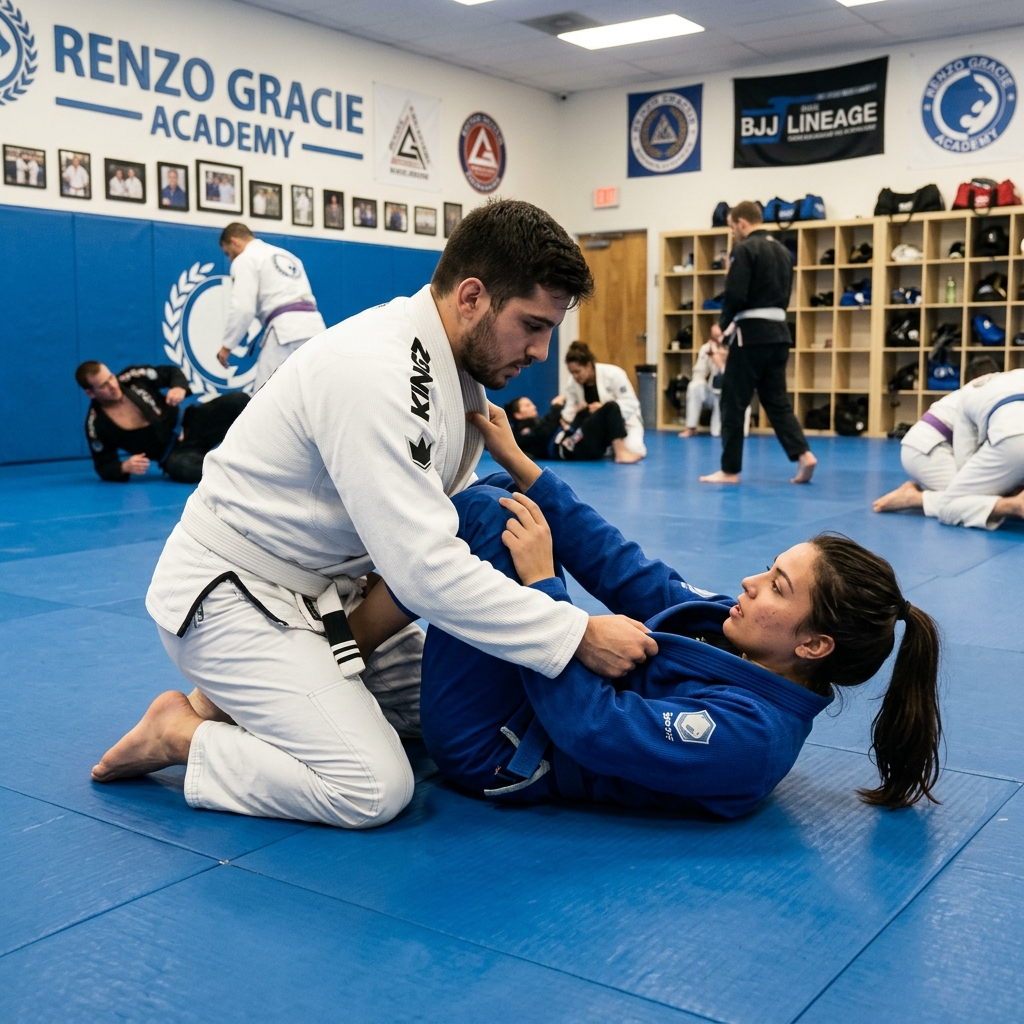
Your first BJJ class will be simultaneously the most humbling and most interesting training experience you’ve ever had. You will be tapped out by people half your size. Your neck will be sore in places you didn’t know had muscles. And you will almost certainly come back.
This guide covers what you actually need to know for the first 6 months, not the romantic version, the practical one.
Week 1-2: What to Expect at Your First Class
Most gyms have a structured beginner program. If yours doesn’t, you’ll be paired with a more experienced partner who walks you through basics during free drilling time.
What happens in a typical class:
- Warm-up (running, shrimping, forward/backward rolls, hip escapes)
- Technique instruction (2-3 positions by the instructor)
- Drilling (repetition of the shown technique with a partner)
- Sparring / rolling (live practice against a resisting partner)
You will be sore in approximately 48 hours in the following areas: neck, shoulders, hips, inner thighs (from guard open/close), and forearms (from gripping). This is normal and peaks around weeks 2-3 before your body adapts.
What to Buy First (And What to Skip)
The Essential Kit (Buy These):
A BJJ Gi (if training gi BJJ): Your first gi should be in the $60-100 range. White is universally accepted. Don’t buy an expensive gi until you know your size post-shrinkage.
Recommended: Fuji All-Around BJJ Gi →, durable, pre-shrunk, accepted at IBJJF events.
A Rashguard (for under the gi or no-gi training): Protects against mat burns and reduces skin infection risk.
Hayabusa Haburi Compression Rashguard →
A Mouthguard: Non-negotiable for sparring. Get one before your first live round.
Sisu Aero 1.6mm Mouthguard →, slimmer profile, allows talking without removal.
Skip (For Now):
- Expensive competition gi
- Performance supplements
- Multiple training DVDs or online programs
- Ankle supports, knee braces (get them when you actually need them, not preemptively)
The 3 Biggest Beginner Mistakes
Mistake 1: Going Hard When You Should Go Light
In your first 3 months, you will have moments where you’re nearly being submitted and your body will spike adrenaline asking you to escape at full force. Resist this.
Relying purely on strength often leads to poor technique and potential injury. your training partners. The faster you learn to “go technical”, to solve positional problems with use instead of force, the faster you improve and the longer your training partners will want to roll with you.
Mistake 2: Treating Every Roll Like a Competition
You are at practice. So is your partner. The point is to learn, not to “win.” Many beginners who focus obsessively on not getting tapped stall their own development because they only use techniques they’re confident in rather than experimenting with new ones.
Tap early, tap often, ask questions immediately after.
Mistake 3: Ignoring Hygiene
BJJ is a skin-to-skin contact sport. Skin infections (ringworm, staph, MRSA) are genuine risks in martial arts training environments. Your prevention protocol:
- Shower within 1 hour of training
- Wash your gi after every session
- Clean fingernails and toenails before training
- Don’t train with open cuts or skin infections, and don’t partner with someone who has them either
How to Progress in Your First 6 Months
Months 1-2, Survival Phase
Goal: survive rolls without panic. Focus on learning the positions (mount, back mount, side control, guard) and the basic escapes from each. You cannot attack effectively until you can survive.
Months 3-4, Pattern Recognition
You’ll begin recognizing recurring sequences. “Every time I’m in this position, this happens.” Start noting which submissions come from which positions for you specifically.
Months 5-6, Beginning to Initiate
You’ll start setting up your own attacks rather than reacting. Pick 2-3 submissions to develop as your primary weapons and start drilling them with intention.
Competition: Should You Comp in Your First Year?
Yes. Not because you’ll win (you likely won’t), but because competition accelerates learning faster than almost any other single thing.
Competition exposes exactly where your technique breaks down under pressure. You’ll come back with more specific questions and train with more purpose for months afterward.
Look for local tournament series with beginner divisions (white belt only), most allow no-gi if you don’t have a gi or aren’t in a gi program.
FAQ
Do I need to be flexible to start BJJ? No. BJJ improves flexibility over time. Complete inflexibility in specific positions (poor hip flexor mobility, tight hamstrings) can slow some techniques, but there are always ways to work around it. Most practitioners see significant flexibility gains within 3-6 months.
Is BJJ good for self-defense? Yes, for one-on-one ground situations. BJJ is widely considered one of the most practical martial arts for controlling and submitting a resistive opponent. It was explicitly developed for smaller people to overcome larger, stronger attackers. Its limitations are in multi-opponent situations and firearm/weapon scenarios.
What’s the difference between gi and no-gi BJJ? Gi BJJ uses the traditional uniform, the fabric of the gi is used as a gripping surface for sweeps, submissions, and control. No-gi uses shorts and a rashguard, eliminating the gi grips and resulting in faster-paced, more wrestling-influenced grappling. Many gyms train both; beginner programs often start with gi.
We evaluate combat sports gear and media independently. To learn more about our editorial standards, read our Editorial Policy.